
75 minutes + hands-on 7-day audit
← Previous: Week 2 (Strategies)
This week we’re digging into:
- Biological cycles vs technical cycles
- Where materials come from and where they go
- Material flows in Tasmania
- Food, plastic, textiles, timber – the real story
- Doing YOUR OWN waste audit (eye-opening!)
Understanding Material Flows
Every product has a journey. From where it comes from to where it ends up. That’s a material flow.
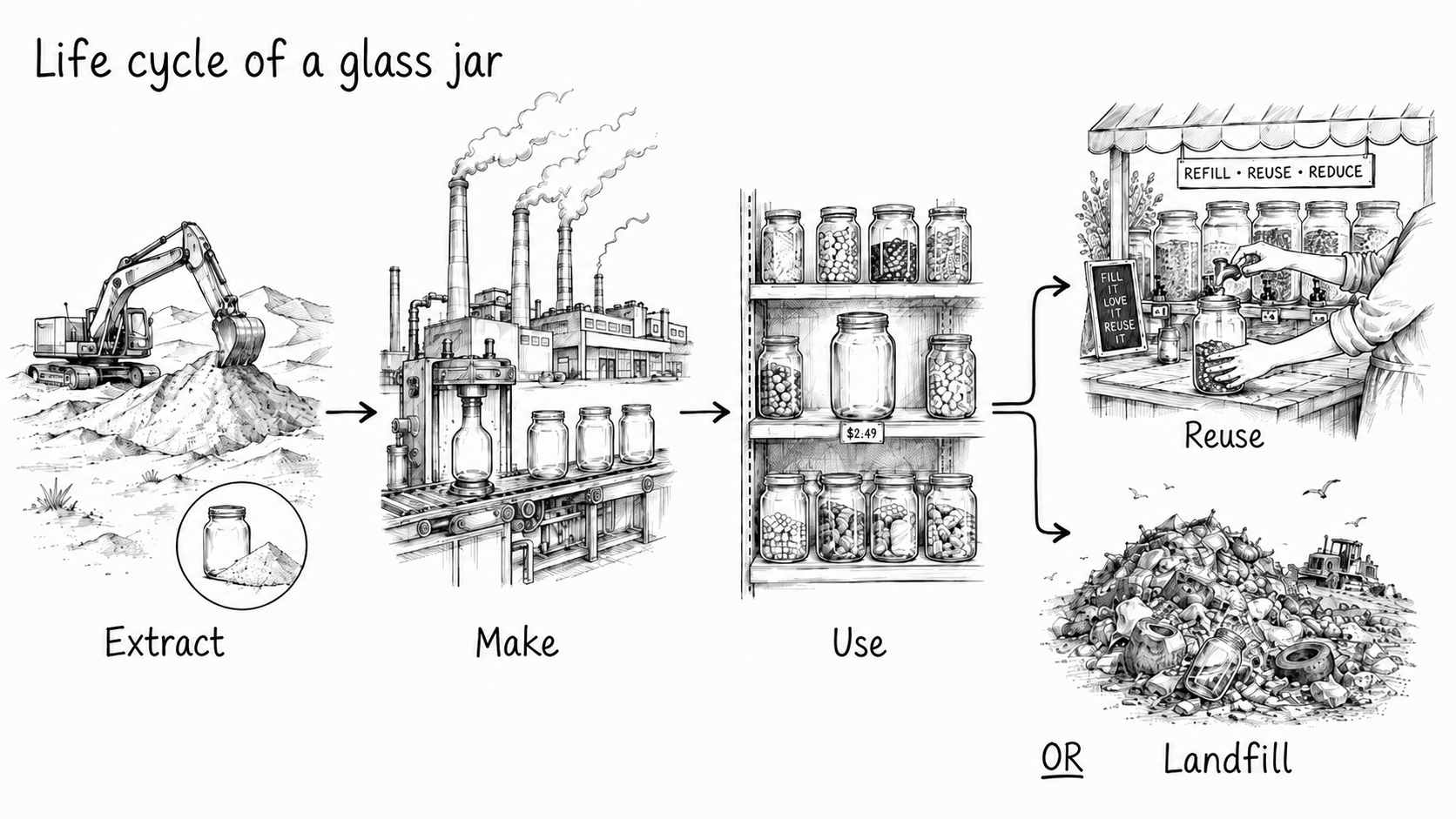
In a linear economy: Extraction → Manufacturing → Transport → Use → Landfill. Dead end.
In a circular economy: Extraction → Manufacturing → Transport → Use → Cycle back (repair, reuse, recycle, regenerate). Keeps going.
Here’s the thing: Most material flows are broken. Materials flow one direction – into landfill. That’s the problem we’re trying to fix.
Two Types of Cycles
Not all materials are the same. Some belong in nature. Some belong in industry. Understanding the difference is key.
🌱 Biological Cycle
Materials from nature that can safely return to nature. Food scraps, paper, cotton, wood, natural rubber. They break down and become soil.
The cycle: Soil → Plant → Product → Use → Compost → Soil (repeat forever)
🔧 Technical Cycle
Materials made by humans that don’t break down naturally. Plastic, glass, metal, synthetic fabrics. They need to be processed and reused in industry.
The cycle: Extract → Manufacture → Use → Recycle → New Product (repeat)
The problem: We’re mixing them up. Biological materials going to landfill (creating methane). Technical materials in nature (polluting forever). Fix the flows, and everything changes.
We are living on this planet as if we had another one to go to.” — Terri Swearingen
Material Flows in Tasmania — What’s Actually Happening
Let’s look at what’s actually happening with our stuff here in Tasmania:
A third of the food we buy ends up in landfill. In landfill it rots, creating methane — a greenhouse gas far more potent than CO2. But food waste is actually one of the easiest material flows to fix.
FOGO — Food Organics and Garden Organics FOGO kerbside collection is rolling out across Tasmania right now — a green-lidded bin for food scraps and garden waste that gets turned into compost instead of rotting in landfill.
Where FOGO is available in Tasmania:
- North West — Devonport, Burnie, Central Coast, Latrobe, Kentish, Waratah-Wynyard councils. Serviced by a brand new $32 million composting facility in Latrobe capable of processing 50,000 tonnes per year
- Brighton, Sorell — FOGO rolling out now
- Check your council — rethinkwaste.com.au has a full list of what’s available in your area
Don’t have FOGO yet?
- Start a home compost or worm farm — kitchen scraps become garden gold
- Check if your council has a community composting program
- Reduce food waste at the source — buy less, plan meals, use what you have
Food waste is a solvable problem. Tasmania is solving it.
Single-use plastic is one of Tasmania’s biggest material flow problems — most of it ends up in landfill or the environment. But Tasmania just launched a major new scheme to change that.
Recycle Rewards — Tasmania’s Container Deposit Scheme Launched 1 May 2025 — Tasmania was the last Australian state to get a container deposit scheme, completing a national network. Now every eligible drink container is worth 10 cents back.
How it works:
- Return eligible drink containers — cans, plastic bottles, glass bottles, cartons
- Get 10 cents back per container at any of 49 refund points across Tasmania with over 100 reverse vending machines
- Or donate your refund to a community group or charity
Find your nearest refund point: 🔗 nre.tas.gov.au/environment/recycle-rewards
Beyond containers — reducing plastic overall:
- Bring your own bags, containers and cups
- Choose products with less packaging
- Visit zero waste shops like Eumarrah or Scoop Wholefoods for package-free shopping
- Use Rethink Waste A-Z guide for what to do with specific plastic items
Tasmania completed Australia’s national container deposit network in 2025 — a big step forward for plastic flows.
Australians are the second largest consumers of textiles in the world. Most donated clothing ends up in landfill — there’s simply too much of it to be effectively reused. The solution starts with buying less and keeping what you have in use longer.
What you can do in Tasmania:
Repair & Mend
- Sustainable Living Tasmania runs clothes swap and repair events with sewing machines, fabric scraps, yarn and skilled people to help you mend your clothes. slt.org.au
- Repair Cafes across Hobart and Launceston can help with clothing repairs
Swap & Buy Secondhand
- Clothing swaps — swap with friends or find community swap events through Sustainable Living Tasmania and local Facebook groups
- Op shops statewide — Vinnies, Lifeline, Hobart City Mission, Salvos
- Facebook Buy/Swap/Sell groups — dozens of local Tasmanian groups
Recycle What Can’t Be Worn
- Charity bins at op shops accept worn or damaged clothing for textile recycling
- H&M and other retailers have in-store textile take-back programs
- The Tasmanian Government is actively working on improving textile waste solutions — watch rethinkwaste.com.au for updates
The most sustainable garment is the one already in your wardrobe.
Tasmania’s timber industry demonstrates genuine circular economy principles in how it processes wood — using every part of the tree, generating near-zero waste at the mill. But the full picture is more complicated.
Where it works well:
- Sawdust → biofuel and energy generation
- Bark → mulch for gardens and landscaping
- Wood scraps → composite materials and particle board
- Offcuts → smaller timber products and craft materials
Where it doesn’t: The circular economy requires that materials are sourced regeneratively — not extracted faster than nature can replace them. Community groups across Tasmania have condemned Sustainable Timber Tasmania for clearfell practices that devastate maturing forest habitats, increase fire risks, and pollute critical waterways. Old growth logging in Tasmania doesn’t look like ending any time soon, despite these forests storing huge amounts of carbon and providing critical habitat. Sustainable Timber Tasmania has also twice failed to achieve Forest Stewardship Council certification. CirculareconomytasmaniaLibraries Tasmania
Exporting timber as woodchips and packaging material — low-value products that could be made from plantation timber — is widely criticised as an inefficient and environmentally unjustifiable use of native forest.
The circular economy lens: Processing timber waste efficiently is circular economy thinking. Logging old growth forests to make woodchips is not. These are two different things happening under the same roof — and it’s worth understanding the difference.
What you can do:
- Choose plantation timber or reclaimed timber for building and renovation projects
- Ask where timber products come from before you buy
- Support businesses using certified sustainable timber
🔗 Bob Brown Foundation — for the conservation perspective 🔗 Sustainable Timber Tasmania — for the industry perspective 🔗 Rethink Waste — for practical timber recycling and reuse options
Tasmania’s forests are extraordinary. How we treat them is a reflection of our values.
📋 YOUR WASTE AUDIT — 7 DAYS
This is the most eye-opening exercise. Track everything you throw away for 7 days. You’ll see patterns. You’ll see opportunities.
What you need: Four bins or bags. Labels: Landfill, Recycling, Compost, Other. Seven days. A notebook.
□ Step 1: Set Up Your Audit
Get 4 containers. Label them clearly. Landfill (stuff going to landfill), Recycling (paper, plastic, metal), Compost (food scraps, garden), Other (reusable, refundable).
□ Step 2: Collect for 7 Days
Everything you throw away goes into the right bin. Be honest. Include work, home, shopping – all of it. Take notes about what surprises you.
□ Step 3: Analyse & Learn
After 7 days: What filled up fastest? What surprised you? Which items are repeat offenders? Which could you reduce, reuse, or repair?
This isn’t about judgment. It’s about awareness. What you measure, you can change. Once you see the patterns, you’ll start changing them naturally.
⚡ Try This in the Next Week
Do your 7-day waste audit.
This is hands-on. This is real. You’ll see your material flows clearly. You’ll see what’s broken about the system. And you’ll get ideas for fixing it. This one exercise will change how you think.
💭 Have a Think (After Your Audit)
- What filled your landfill bin fastest?
- What surprised you most?
- Which item would be easiest to eliminate?
- What could you reduce starting tomorrow?
Don’t just think about it. Write it down. These answers are your starting point for action.
💬 Questions or Feedback?
Got a question about this week’s content? Something that didn’t make sense, or something that sparked an idea? We’d love to hear from you — this course gets better every time someone tells us what’s working and what isn’t.
📖 Key Terms This Week
- Material Flow — the movement of resources through the economy from extraction to end of life
- Biological Cycle — materials that can safely return to nature through composting or biodegradation
- Technical Cycle — materials like metals and plastics that should be recovered and reused industrially
- Landfill — a site for disposing of waste by burial — in circular economy thinking, a last resort
- Biodegradable — able to be broken down naturally by living organisms
Week 3 done! 🎉 Plus an eye-opening audit. Next: Week 4 (Building Local) →